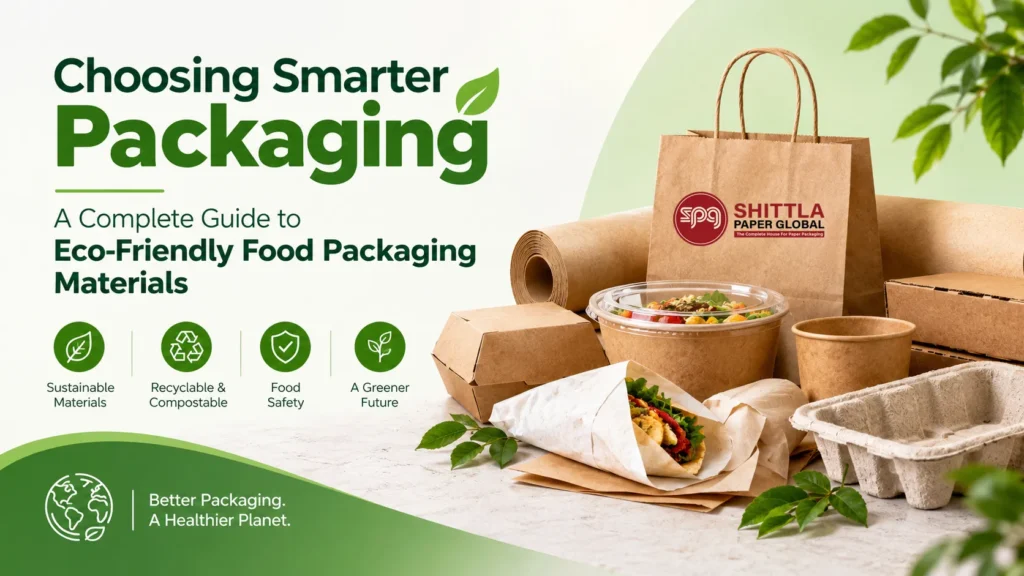
There are a lot of changes in the food packaging industry as companies, consumers, and manufacturers seek packaging that is effective, safe, and more environmentally friendly. Food packaging serves the purpose of protecting the food, ensuring its freshness, facilitating transport and giving consumers information about the products. Also, the increasing concerns about reducing waste have brought attention to environmentally friendly materials.
At Shittla Paper Global, we realize that future food packaging demands a blend of functionality, food safety, effectiveness and responsible choice of materials. In this guide, we will discuss all types of environmentally friendly food packaging materials and their properties.
Table of Contents
What Is Eco-Friendly Food Packaging?
The concept of eco-friendly food packaging describes packaging materials that are intended to be environmentally friendly while carrying out the required tasks of food protection and handling. Depending on the packaging material and usage, the above terms may include either recyclable, compostable, biodegradable, renewable, or efficient packaging materials.
However, being eco-friendly in nature does not necessarily imply that the packaging material is fit for all uses. The eco-friendliness of the packaging material is also affected by many other factors including materials used, manufacturing process, distribution, usage, and disposal methods. Learn more about our commitment to sustainability.
Why Is Sustainable Food Packaging Important?
Traditional food packaging can generate considerable amounts of waste in cases where the materials are hard to recover or are used excessively. Thus, food companies are looking into ways of using packaging that can minimize the amount of materials used without compromising on the performance of the packaging. There are several advantages that eco-friendly packaging can have:
- Aid in minimizing the use of certain non-renewable materials
- Easier to use recyclable/renewable materials
- Help in minimizing unnecessary packaging due to lightweight design
- Allow waste management
- Conform to consumer interest in environmentally friendly packaging
- Aid in developing sustainable packaging strategies
However, the most important thing is to ensure that the right packaging protects the food effectively. Explore our finished paper products for sustainable options.
Common Eco-Friendly Food Packaging Materials
Eco-friendly food packaging materials are designed to minimize environmental impact by being biodegradable, compostable, or recyclable. These materials help reduce waste and carbon footprints in the food industry.
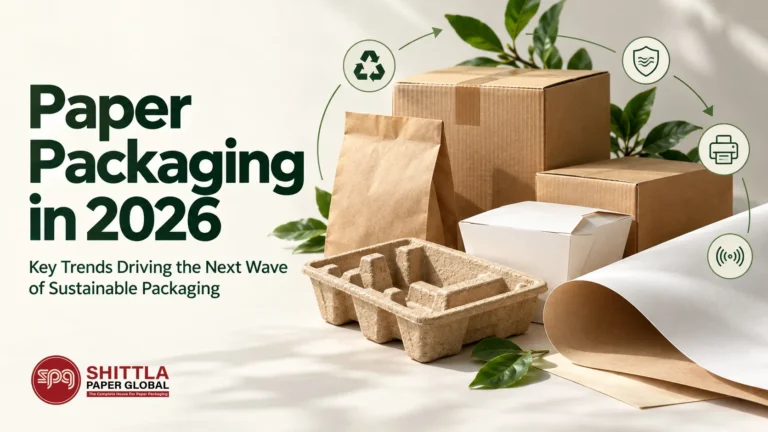
Paper and Paperboard
Paper is one of the most commonly used materials used in packaging of food. This material is composed mainly of cellulose fibers and can be obtained from sustainable sources.
Paper and paperboards are useful in food packaging, wrapping, corrugated boxes, take-away containers, baked food packages, foodservice packaging, and many other packaging uses. The printability of these materials also makes them useful in brand messaging. The paper should be properly manufactured and converted for the specific application where it is meant to be used in food packaging. Discover our printing and paperboard solutions.
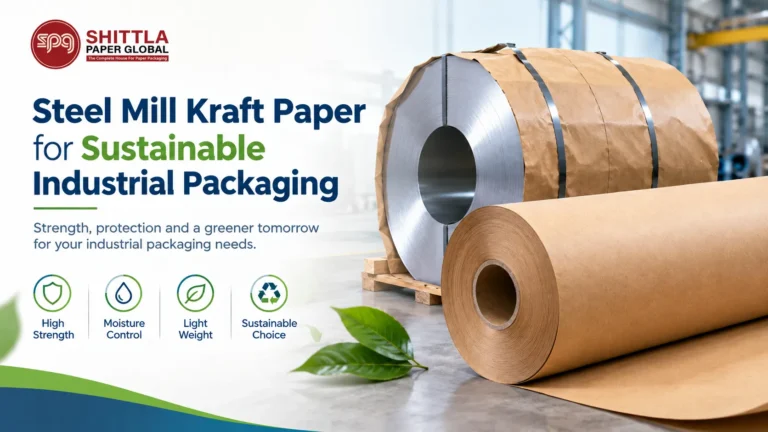
Kraft Paper
Kraft paper is popular for its durability, flexibility, and natural look. Its uses include bags, wrapping paper, pouches, takeaway containers, and outer packing. It has good strength and printability, making it suitable for brands that want functional and paper-looking packaging. Explore our Kraft Paper solutions for your business.
Butter Paper and Food Wrapping Paper
Food packaging butter paper is used for wrapping, lining, serving, and packaging various food items. Depending on its specification, it can provide attributes such as grease resistance, smoothness, strength, and non-stickiness. The performance of paper is one of the major issues at Shittla Paper Global because food packaging should be functional and protective. Check out our customized butter paper options.
Corrugated Fibreboard
Corrugated fiberboard is made up of paper layers that are meant to add strength and cushioning to the structure. Corrugated fiberboard is commonly used in the movement of food products and in second-stage packaging. It provides protection against impacts and offers adequate surface area for printing purposes. Check out our papers for the corrugation industry.
Moulded Fibre Packaging
Moulded fibre is made when the fibrous material is shaped into particular structures. This can be used in trays, inserts, and foodservice packaging, among other uses.
The flexibility in being shaped makes it a suitable material in instances where firms require packaging that offers protection as well as a fibrous solution. Learn about our fibrous packaging solutions.
Compostable Materials
Some types of food packaging can be composted under certain conditions. Compostable packaging must not be confused with biodegradable packaging since the two types are different from one another.
Companies should first consider the certification and composting process of these packaging types before choosing them. Explore our eco-friendly initiatives.
Important Properties of Sustainable Food Packaging
Choosing environmentally sustainable packaging does not just involve assessing its environmental credentials. Packaging is meant to perform efficiently within its intended application cycle. The following features are important in such packaging material:
- Food safety – Food contact packaging materials should be able to conform to the relevant food contact specifications.
- Strength – Packaging materials should be strong enough to endure transportation, handling, stacking and storage.
- Barrier properties – Many foodstuffs are made up of fats, sauces or moisture content hence the need for barrier properties.
- Printability – Packaging material should give adequate surfaces for labeling among other functions.
- Heat resistance – Some applications may require packaging materials that are heat resistant.
- Product protection – Packaging materials should be efficient in product protection.
Learn more about our barrier-coated papers for enhanced protection.
How to Select the Right Eco-Friendly Packaging Material
There is no single packaging material that works for every food product. Businesses should consider:
- Type of food – Dry, oily, moist, frozen, hot, or ready-to-eat foods have different requirements.
- Required shelf life – Packaging should provide the necessary level of protection.
- Barrier properties – Consider grease, moisture, oxygen, aroma, or other relevant barriers.
- Packaging format – Decide whether the product requires sheets, rolls, boxes, bags, trays, or another format.
- Food-contact compliance – Confirm that the material is appropriate for its intended food-contact application.
- End-of-life options – Consider whether the packaging can realistically be recycled, composted, or otherwise recovered in the target market.
- Overall material efficiency – Avoid excessive packaging while maintaining adequate product protection.
Consult our food industry experts for the right choice.
The Role of Paper Manufacturers in Sustainable Packaging
It is crucial for paper mills to develop packaging solutions that consider both performance and environmental aspects. Quality, right fibre choice, efficient production processes, and proper specifications could help achieve better packaging solutions.
At Shittla Paper Global, we are dedicated to providing paper solutions according to the evolving requirements of the industries, keeping quality and consistency in mind. Explore our MG and Kraft paper production.
The Future of Eco-Friendly Food Packaging
Food packages in the future will be more focused on being efficient with materials, recyclable, sustainably sourced, having better barriers, and application-specific packaging design.
Sustainability should not be seen as a simple exchange of one material for another. Rather, sustainability means looking at the entire package concept from the beginning of its creation until the end of its life.
Conclusion
Eco-friendly food packaging is fast emerging as a vital element in today’s food industry. Paper, kraft paper, food wrapping papers, corrugated fibreboard, molded fibre and compostable packaging that are properly designed can meet different packaging requirements based on their unique characteristics.
For the food industry, what matters most is the packaging option that combines food safety, durability, functionality, material efficiency, and proper disposal.
At Shittla Paper Global, we strongly believe that the innovative use of paper packaging will help you achieve practical food packaging options.