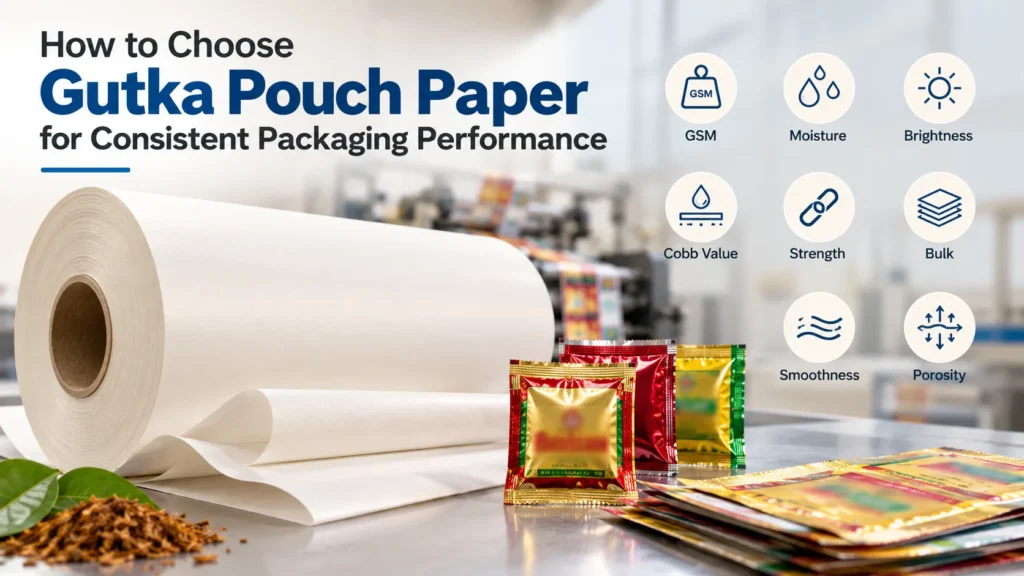
The paper used for packaging products like gutka and pan masala plays a significant role beyond serving as a printing surface. Gutka pouch paper quality directly influences printability, pouch durability, moisture control, converting efficiency, and overall packaging performance.
For packaging companies working with established brands and manufacturers in the pan masala industry, including Manikchand Group, Dharampal Satyapal Group (DS Group), Vimal Pan Masala Company, Shikhar Group, and Rajshree Group, selecting the right paper grade is essential for consistent packaging quality.
At Shittla Paper Global, we focus on paper properties that support efficient packaging operations. Important technical parameters include GSM, ISO brightness, Cobb value, moisture content, bulk, smoothness, porosity, and breaking strength.
Understanding these specifications helps manufacturers and converters make informed paper sourcing decisions.
Table of Contents
When Packaging Problems Start with the Paper
- High or inconsistent moisture content can affect dimensional stability during printing and converting.
- Insufficient paper strength can increase the risk of breakage during handling.
- Poor surface characteristics can affect printing quality and consistency.
- Uncontrolled absorbency can influence ink and coating performance.
These challenges are also discussed in our article, When Packaging Fails: How Non-Standardised Paper Quality Can Hurt Your Brand, which explains why consistent raw material quality matters across packaging applications.
GSM: The Starting Point for Consistent Paper Selection
For a broader understanding of application-specific paper selection, read our guide on How to Choose the Right Paper for Gutka Packaging.
Moisture Control for Better Processing Stability
Moisture content is a critical factor in paper packaging performance. Excessive or inconsistent moisture can affect paper behaviour during printing and converting.
Potential problems include:
Dimensional changes
Paper curling
Feeding difficulties
Inconsistent converting performance
The specified paper has a moisture content of 7.0% ±1.0%.
Maintaining moisture within the required range can support better dimensional stability, consistent processing, and smoother machine operations.
For pouch manufacturers, moisture control should be an important part of incoming material quality checks.
Brightness: Creating a Better Printing Base
The appearance of the paper surface is particularly important for printed packaging.
ISO brightness measures the reflectance of paper under specified testing conditions.
The specified paper has an ISO brightness of 85.0% ±2.
Consistent brightness can provide a more uniform printing base and help maintain the visual appearance of packaging graphics.
For manufacturers producing printed pouches, uniform paper brightness supports consistent packaging presentation across production batches.
Strength That Supports High-Speed Converting
Gutka pouch paper must withstand several manufacturing processes, including printing, slitting, folding, handling, and converting.
Therefore, paper strength is an essential selection criterion.
The specified technical values include:
- Burst Factor: 28 (+2)
- Breaking Length (MD): 6500 metres
- Breaking Length (CD): 3300 metres
MD (Machine Direction) refers to the direction in which paper travels through the paper machine, while CD (Cross Direction) refers to the perpendicular direction.
Evaluating strength in both directions helps converters understand how the paper may respond to mechanical stress.
Selecting paper with suitable strength characteristics can reduce the risk of paper breakage and production interruptions.
The importance of paper strength across packaging applications is also explained in Why Packaging Fails in Quick Commerce & How Paper Quality Fixes It.
Cobb Value: Managing Water Absorption
Cobb 60 is a technical parameter used to measure the amount of water absorbed by paper during a specified 60-second test.
The specified gutka pouch paper has a Cobb 60 value of 25 g/m² (+2).
A controlled Cobb value can support predictable interactions between paper and moisture, inks, coatings, or other materials used during packaging operations.
For packaging converters, consistent water absorption characteristics contribute to more predictable processing performance.
Smoothness and Porosity: Small Numbers, Big Processing Impact
Paper smoothness and porosity are important surface-related properties that can influence printing and converting operations.
The specified values are:
Smoothness: 80–100 ml/min
Porosity: 60–70 ml/min
Smoothness influences the contact between the paper surface and printing or converting equipment.
Porosity relates to the passage of air through the paper structure and may influence certain coating and converting processes.
Consistent smoothness can support uniform printing, while controlled porosity helps maintain predictable paper behaviour.
These characteristics demonstrate why paper quality should be evaluated through the performance of the entire sheet rather than GSM alone.
Bulk: Understanding Paper Structure
Bulk describes the volume occupied by a given mass of paper and is commonly expressed in cc/g.
The specified paper has a bulk value of 1.06 cc/g.
Bulk provides information about paper structure and may influence how the sheet behaves during handling and converting.
When selecting gutka pouch paper, bulk should be considered alongside GSM, strength, moisture, and other relevant specifications.
A Practical Quality Checklist for Gutka Pouch Paper
Before finalising a paper grade, manufacturers and converters should evaluate the following technical parameters:
| Technical Parameter | Specification |
|---|---|
| GSM | 47 g/m² ±2 |
| Bulk | 1.06 cc/g |
| ISO Brightness | 85.0% ±2 |
| Cobb 60 | 25 g/m² (+2) |
| Burst Factor | 28 (+2) |
| Breaking Length (MD/CD) | 6500 / 3300 m |
| Smoothness | 80–100 ml/min |
| Porosity | 60–70 ml/min |
| Moisture | 7.0% ±1.0% |
Evaluating these parameters together provides a more complete understanding of paper quality and helps determine whether a particular grade is suitable for the intended printing and pouch-converting application.
Manufacturers should also verify testing methods, tolerances, and compatibility with their specific converting equipment.
Choosing Paper Quality That Solves Packaging Problems
The same principle of quality consistency is explored in our article, Why Indian Brands Need to Switch to Make in India Packaging Papers.
Looking for paper solutions that match your converting requirements? Contact Shittla Paper Global to discuss technical specifications, paper grades, and bulk sourcing enquiries.