
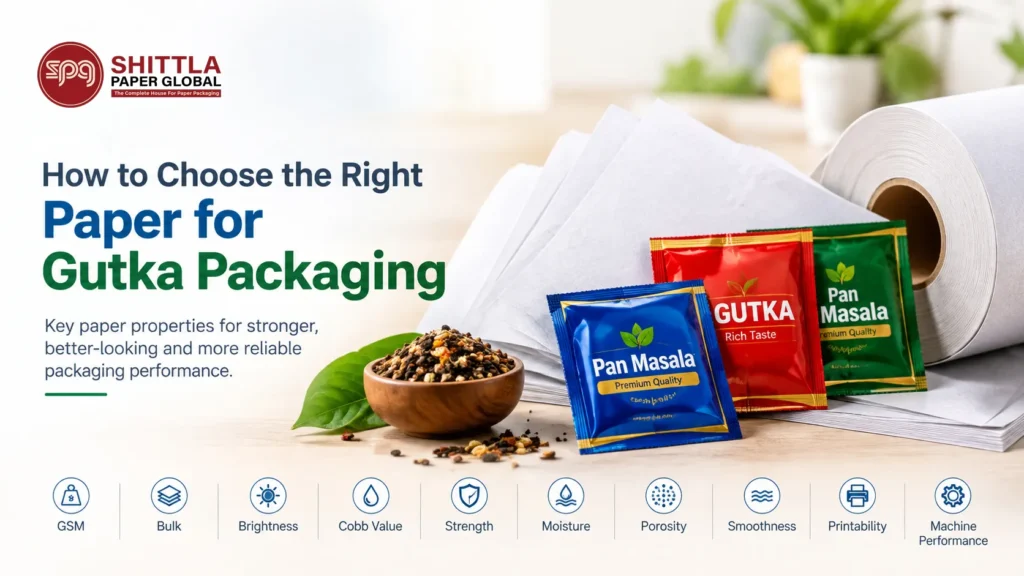
Although the packaging of Gutka and pan masala might appear very basic, the paper that goes into this packaging is actually very important for the performance of the package as a whole. Be it the printing, appearance, or the strength, moisture,e and machine performance, every attribute of the paper could affect the end result.
The established companies in the field of pan masala and mouth-fresheners like Manikchand Group, Dharampal Satyapal Group (DS Group), Vimal Pan Masala Company, Shikhar Group and Rajshree Group have to operate in a very competitive environment when it comes to packaging.
Therefore, for manufacturers, making the decision of paper for packaging only based on the cost and GSM would bring about complications like tearing, poor printability, moisture-related problems, inconsistent feeding, and inefficient production.
At Shittla Paper Global, effort is put into understanding the technical aspects of paper, which makes it a good choice for gutka packaging paper. The following are the key attributes to be considered by the manufacturer while choosing the paper for gutka packaging.
Table of Contents
Start With the Application, Not Just GSM
One of the most frequent errors made when choosing packaging paper is taking into consideration the GSM factor alone. While GSM (Grams per Square Meter) determines the weight, it doesn’t always reflect the strength or durability of the paper. You must look at the application requirements first.
Paper Strength: Bulk and Burst Factor Matter
Packaging papers require adequate strength to endure the process of printing, folding, conversion, transportation, and filling. Without the right strength parameters, the paper may tear or fail during high-speed machine operations.
Bulk
Bulk is the measurement of volume/thickness relative to weight. For gutka packaging, a higher bulk is often preferred because it provides a sturdier feel without necessarily increasing the weight (GSM) of the paper.
Burst Factor
Burst factor is the ability of the paper to withstand pressure. In the context of gutka pouches, a high burst factor ensures that the packaging doesn’t rupture or leak during transit or handling.
Brightness and Surface Quality for Better Printing
Gutka and pan masala packaging always involve proper printing of their brand names, product details, graphics and other aspects. Hence the quality of paper used for printing becomes highly significant.
ISO Brightness
A level of about 85% ISO brightness can produce bright and white paper, which will improve the visibility of printed graphics. High brightness ensures that the colors of your brand stand out and look premium on the shelf.
Smoothness
Smoothness produces even interaction of the paper and ink. A smoothness level of approximately 80 to 100 ml/min (depending on the test method) ensures sharp printing and prevents ink bleeding or smudging.
Moisture Control: Why Cobb Value Is Important
Moisture content is among the most essential elements when it comes to quality of packaging paper. One cannot describe paper as “moisture free.” Manufacturers need to ensure that the paper has controlled moisture content and proper water absorption capacity.
Cobb 60
Cobb 60 test determines the water absorption capacity of the paper. For gutka packaging, a low Cobb value is critical to prevent the paper from absorbing moisture from the environment or the product itself.
Moisture Content and Batch-to-Batch Consistency
Apart from the Cobb value, the actual moisture content of paper also plays an essential role.
The use of a moisture specification with a target of about 7.0%, with ±1.0% tolerance, may be useful for achieving more consistent performance of paper during production.
The variations in moisture may lead to:
- Curling
- Dimensional variation
- Batch feeding difficulties
- Variations in stiffness
- Variations in printing performance
- Variations in machine settings
This is especially true for large-scale packaging production since batch-to-batch consistency is critical.
Porosity and Machine Performance
Paper used for packaging must not only look good; it must also run well on high-speed production and converting machines.
Porosity is an indicator of how readily air travels through the paper. It may affect printing, drying, coating, and converting of the paper.
Porosity values between 60-70 ml/min, together with the correct tolerance, could be considered as a component of the technical specification of the paper for its intended purpose.
The poor feeding, uneven drying, or problems with converting may be due to the properties of the paper and must be evaluated systematically.
Don't Ignore Breaking Length
Burst factor is not the only way to measure strength. Breaking length measures the tensile strength of the paper. A higher breaking length means the paper can sustain more tension on high-speed packaging machines.
What Makes Good-Quality Paper for Gutka Packaging?
Good packaging paper must provide a balance among all properties, such as strength, printability, moisture resistance, surface characteristics, and machine performance.
Rather than asking, “What is the GSM?” alone, manufacturers need to consider:
- GSM – 47 g/m² approx. for the particular application
- Bulk – 1.06 cc/gm approx.
- Brightness – 85% ISO approx.
- Cobb 60 – 25 g/m² approx.
- Burst Factor – 28 approx.
- Breaking Length – 6500 m MD / 3300 m CD
- Smoothness – 80 – 100 ml/min approx.
- Porosity – 60 – 70 ml/min approx.
- Moisture – 7.0% approx.
All these specifications are suggested application-specific reference values and not a requirement for all gutka or pan masala packaging applications.
Why Consistency Is More Important Than Compromise
When dealing with packaging for products which need to be offered in a competitive market by packaging manufacturers, consistency may often prove to be more important than opting for the most inexpensive paper.
Paper may be the appropriate one to use in terms of GSM but can cause trouble in case the moisture content, brightness, strength, Cobb value, smoothness, bulk or porosity differs widely from paper to paper.
In cases of packaging which are linked to the brand names like that of Manikchand Group, Dharampal Satyapal Group (DS Group), Vimal Pan Masala Company, Shikhar Group and Rajshree Group, the consistency of the packaging along with reliable performance during manufacturing may prove to be very important.
Therefore, the ideal paper should be:
- Consistent in GSM
- Controlled moisture
- Appropriate Cobb value
- Brightness
- Strength
- Bulk
- Porosity
- Smoothness
- Printability
- Machine Performance
Choose Paper Quality That Supports Your Production
The ideal gutka packaging paper will not be necessarily the one which is the heaviest, the brightest, or the cheapest. The ideal packaging paper should have the ability to deliver the necessary strength, surface properties, moisture resistance, printability, and converting ability.
Understanding this criteria makes it easier for the manufactures of gutka packaging paper to make the correct decision without having to base their judgment on the GSM or the price of the paper.
When all these criteria such as GSM, bulk, brightness, Cobb 60, burst factor, breaking length, smoothness, porosity and moisture content are evaluated, it becomes much easier for the manufacturers to make a correct choice.
It goes beyond choosing just any kind of raw material; it involves choosing a package solution that works well all through.