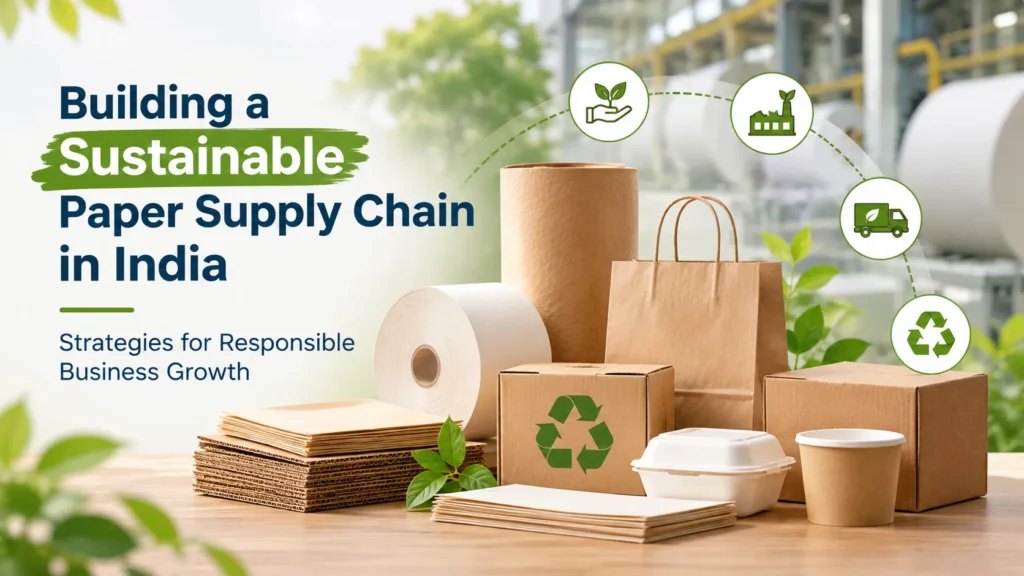
Sustainability is becoming a critical aspect in the Indian industry due to the emphasis on the need to minimize environmental effects, improve efficiency and resource utilization, and cater to shifting customer demands. The paper industry in particular is a crucial player in the shift towards sustainability owing to the wide use of paper in packaging, printing, manufacturing, food wrapping, and industrial applications. Therefore, the creation of a sustainable paper supply chain is imperative for companies that wish to be efficient and sustainable.
Shittla Paper Global recognizes that proper sourcing of paper, manufacturing, and distribution is an integral part of creating a sustainable paper supply chain. Through practical approaches, Indian firms can minimize wastage, improve resource utilization and have better relations with their suppliers.
Table of Contents
1. Choose Responsible Paper Suppliers
Choosing responsible suppliers is the first step to achieving a sustainable paper supply chain. The businesses need to consider several factors when choosing the suppliers including quality of the product, methods of manufacture, environmental performance, and transparency in sourcing of materials.
Partnering with reputable paper manufacturers will ensure that the quality of the products will be constant and thus reduce wastage of materials due to poor quality products. It is necessary to ask the suppliers about their source of raw materials, their use of energy, how they manage wastes, and whether they have any environmental certificates. This will help achieve sustainable supply chains.
2. Prioritise Recycled and Responsibly Sourced Raw Materials
The choice of raw materials affects the environmental impact of paper manufacture directly. Based on the use and the performance criteria of the product, companies can opt for recycled paper, responsibly sourced virgin fibers or a combination thereof.
Recycled paper allows companies to cut back on their reliance on virgin fibers and keep recoverable paper waste out of landfills. But the applicability of recycled paper will depend on aspects like strength, cleanliness, brightness, and intended use. If products are needed with certain performance criteria, virgin fibers would need to be considered by companies. It is important for companies to look at their performance requirements before making any sourcing decisions. Food contact paper needs to adhere to food safety regulations in addition to being sustainable.
3. Improve Resource Efficiency in Manufacturing
Sustainable manufacture of paper involves the efficient utilization of water, energy, and raw materials. Manufacturers of paper can decrease their ecological footprint through monitoring the amount of resources consumed, maintenance of equipment, and use of manufacturing techniques that eliminate losses.
Examples of practical strategies include scheduling production effectively, minimizing paper breakages, enhancing precision in cutting, and recycling process materials where applicable. Maintenance of equipment may also assist in avoiding unnecessary use of energy and production of defective products.
The buying firms can help through providing precise specifications of requirements, estimating the demand for paper and eliminating rush orders. Collaboration between the manufacturers and the buying firms assists in avoiding unnecessary production and waste of materials.
4. Reduce Packaging Waste and Improve Material Utilisation
Packaging is a crucial aspect of the paper supply chain for manufacturers, distributors, retailers, and online businesses. Proper selection of packaging materials and sizes can save on the use of materials without hindering product protection.
Businesses need to evaluate if the packaging process can be simplified or even made recyclable or with appropriate recycled materials used. Appropriate protection during storage and transit is also an essential consideration in the selection of packaging.
Industrial products require proper selection of paper grade, weight, and size for improved material efficiency. Industrial papers that cater to different needs, like protective paper for handling glass and paper for corrugated boxes, are useful for companies to perform well and avoid unnecessary wastage.
5. Build an Efficient and Reliable Distribution Network
Transportation will have an environmental impact on the supply chain for paper. Improper routes, partial vehicle loads, and unnecessary transportation can lead to higher fuel usage and logistic expenses.
Indonesian firms can enhance their logistic efficiency through order consolidation, planning of transportation routes, scheduling of dispatching, and cooperation with reliable logisticians. In some cases, the use of suppliers closer to production facilities or large distribution hubs could also help to cut down on transportation.
Proper inventory control is of equal importance. Keeping proper inventory levels enables organizations to avoid urgent shipments, stock piling, and the possibility that paper products will be stored in improper conditions.
6. Strengthen Waste Management and Recycling Systems
An effective waste management system is important to enhance the circularity of the paper supply chain. Companies need to assess ways to ensure that paper waste is segregated in a manner that allows reuse of offcuts, if appropriate, or sending of waste to authorized recyclers.
This can be achieved by putting in place a process within the manufacturing plants to collect, store and monitor the amount of paper waste. Workers also need to be educated on how to segregate paper waste from other contaminants, which cannot be recycled using normal recycling processes.
7. Use Technology to Improve Supply Chain Transparency
Through digital solutions, corporations can increase the transparency and effectiveness of their paper supply chain. Procurement tools, inventory management software, and the performance dashboard of suppliers enable companies to track orders, delivery time, material consumption, and wastage.
Organizations can create sustainability indicators such as wastage of paper per production unit, recycling rate, energy consumption, delivery efficiency, and supplier compliance.
Reviewing the sustainability indicators periodically will allow companies to discover any deficiencies in the operation and evaluate if their sustainability efforts are producing results.
8. Evaluate Suppliers Beyond Price
Despite its significance, basing supplier choice only on purchase costs is not entirely healthy and might be problematic after some time because of the quality issues, delays in shipments, high defect rate, and bad communication, which can lead to an increase in the overall procurement cost.
When it comes to evaluating potential suppliers, companies need to consider a number of different factors, including the performance of their products and services, deliveries, quality control, environmental management, technical support, and responsiveness. At Shittla Paper Global, we understand the need for reliable paper solutions that are in compliance with your needs and ensure effective resource consumption.
Conclusion
In order to create a sustainable paper supply chain, there is a need for an integrated process that involves responsible sourcing, efficient production processes, waste reduction, effective logistics, and performance measurement. Indian companies can take significant steps in this regard through collaboration with reliable suppliers, selection of appropriate materials, greater resource efficiency, and effective supply chain management.
Shittla Paper Global believes that it is necessary for sustainability and performance to be related concepts in the case of businesses. Through intelligent purchases and supplier relationships, businesses can minimize unnecessary wastage, improve supply chain reliability, and become more efficient when it comes to resources used. The creation of a sustainable paper supply chain does not happen due to a single measure but results from a series of improvements along each stage of the process.