In the extremely precise glass manufacturing sector, consistency is no less than a necessity rather than an aspect of quality alone. It is used in construction, the automobile industry, solar panels, and even fancy decorative glasses; manufacturers always need glass interleaving materials in their production process. The main problem faced by most of the manufacturers in the UK glass manufacturing industry, as well as in other global industries, is longer lead times for glass interleaving materials, which ultimately results in shade inconsistencies in products.
At first glance, shade inconsistency might seem like a minor issue. But when it comes to real issues, it affects customers’ perspectives, product acceptance criteria, and production efficiency.
Table of Contents
Understanding the Problem: Why Lead Times Matter More Than Ever
In today’s world, the extended cycle time in procuring raw materials has become more of a norm than an exception. Factors contributing to delays in sourcing include transport delays, irregular production schedules, and varying vendor performance.
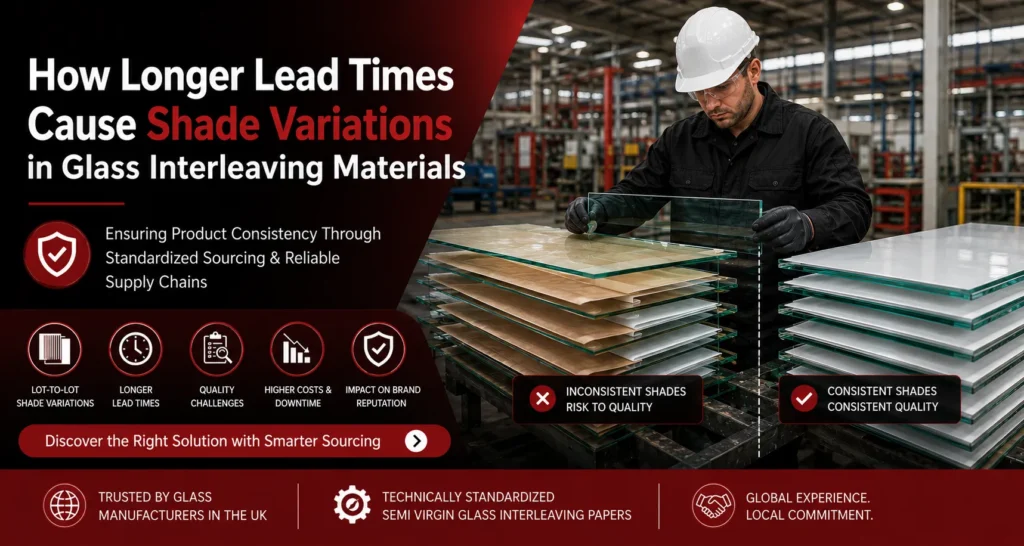
When it comes to manufacturers sourcing Semi Virgin Glass Interleaving Paper, late deliveries can compel them to procure from alternative suppliers and other batches. This poses one primary problem—lot-to-lot shade inconsistency.
Consider the manufacture of premium glass items intended for large-scale building projects in the UK; visual uniformity becomes of extreme importance here. Any variance in shade in terms of the interleaving paper will result in visible inconsistencies in packaging and handling.
For manufacturers supplying premium brands, the inconsistency is likely to result in:
- Customer complaints
- Possible product rejections
- Damage to brand image
- Higher cost of operations
- Possible downtime
Perhaps, more importantly, inconsistency can disrupt quality assurance systems, where manufacturers rely on the standardization of performance across various production units.
How Lot-to-Lot Shade Variations Affect Product Consistency
1. Variation in Product Appearance
High-end glass manufacturers always set high aesthetic standards. Inconsistent colors in different paper lots lead to aesthetic variation during transportation and stacking. Appearance consistency is a key requirement when a company exports to quality-oriented countries like the United Kingdom.
2. Decreased Manufacturing Certainty
With unpredictable product quality in procurement, manufacturing departments feel wary. This is because each delivery necessitates further quality assurance checks.
3. Hardship in Multi-Vendor Production
Most prominent manufacturers either manufacture products from different locations or use several suppliers. It is impossible to achieve consistency without standard materials. Leading global brands like Saint-Gobain, Pilkington, Guardian Glass, and AGC Glass Europe are well aware of the significance of standard materials in achieving production consistency.
4. Production Downtime in Order to Check Quality
If there are inconsistencies in raw material qualities from batch to batch, the manufacturer will stop its production process for quality checking procedures.
The Root Cause: Poor Standardization and Unreliable Supply Chains
In actuality, lengthy lead time is not the sole issue here. Rather, a more significant issue is the lack of uniform technical standards on the part of the suppliers. Indeed, many suppliers have difficulty sustaining consistent manufacturing standards over long periods of production. Slight variations in the quality of materials used, pulp content, production environment, and coating processes may cause discrepancies in color shades between batches. This issue poses significant challenges for companies supplying premium markets such as the UK.
The Solution: Smarter Procurement and Technically Standardized Materials
Rather than relying on reactive measures, businesses should explore proactive methods of sourcing.
1. Sourcing from a Technically Standardized Supplier
Selecting suppliers that have high quality parameters can greatly help in avoiding shading variations. The importance of consistency cannot be overstated when it comes to glass interleaving. Therefore, at Shittla Paper Global, all of our Semi Virgin Glass Interleaving Papers are produced under strict quality guidelines in order to achieve a constant look and functionality. Moreover, our materials can even be modified to suit different needs, allowing businesses to remain consistent without hampering efficiency.
2. Buffer Stock Maintenance
An effective method of coping with increased lead times is through inventory management. Firms can avoid having issues during sourcing periods through proper demand estimation and stocking enough materials at all times. This way, firms do not need to source additional materials on an urgent basis, minimizing chances of variation.
3. Standardization of Specifications Across Different Suppliers
Businesses running operations at multiple locations need to formulate set technical standards for interleaving materials.
This could include things such as:
- Shading standards
- GSM standards
- Smooth surface specifications
- Moisture content controls
- Strength specifications
4. Partnering with Suppliers Possessing Worldwide Knowledge
Experience at the international level is important. With its presence established in the United Kingdom, Shittla Paper Global excels in offering paper products with technical standards across different suppliers and production sites. This is especially useful for manufacturers that are dealing in demanding industries where even the slightest of inconsistencies can lead to major problems.
Why the UK Market Prioritizes Product Consistency
The UK glass manufacturing industry has been making an effort to emphasize premium quality, sustainability, and reliable supply chain partnerships in recent times. Firms involved in producing glass materials for construction, automobiles, and other industries cannot compromise on any inconsistency that may impact their reputation and business operations. With increasing competition in the market, companies that have made efforts to establish reliable sourcing practices have managed to secure several advantages including:
- Higher levels of customer satisfaction
- Fewer product rejections
- Increased productivity
- Improved brand image
- Cost savings
Final Thoughts
However, although the effects of longer lead times on lot-to-lot color variation may appear to be purely a problem of logistics, the potential consequences could be quite significant. The crucial point in overcoming this obstacle is not only the ability to find the material quickly but also choosing the right manufacturer who adheres to production technical standards. This is why at Shittla Paper Global, we continue supporting manufacturers with our best Semi Virgin Glass Interleaving Paper that is made to perform. After all, when your manufacturing process relies on exactness, each time you produce a certain item, the batch needs to perform the same. As our presence expands within the UK market, we will keep assisting global glass manufacturers with obtaining reliable quality.